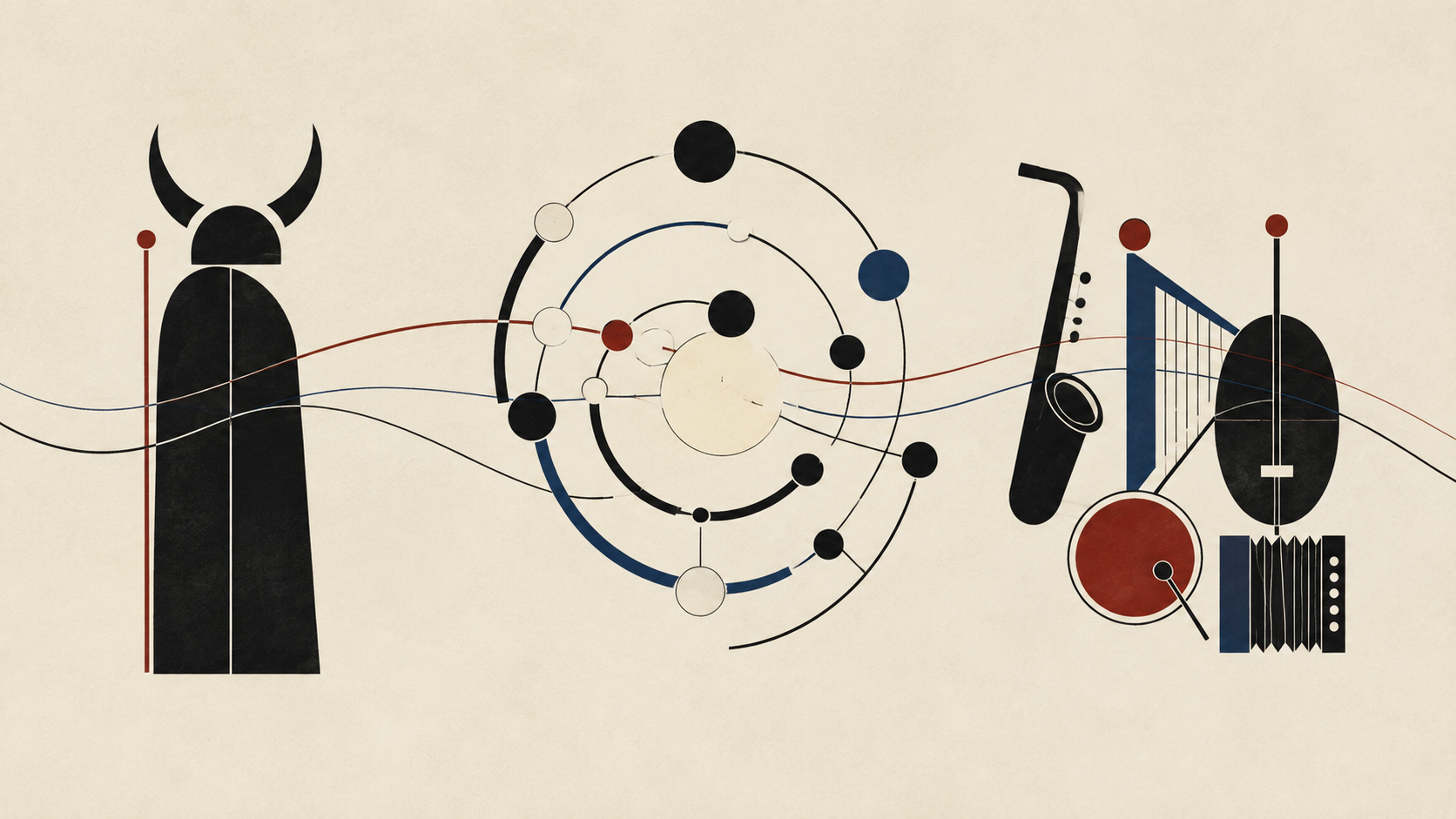
Moondog Vs. Parels Ensemble: The Same Strange Machinery
I have been listening back and forth between Moondog and Parels Ensemble, particularly Parels Ensemble’s Baroque Pearls and Joanna MacGregor’s Sidewalk Dances: Fourteen Moondog Pieces, and the similarity keeps catching me sideways. Not similarity in the ordinary sense—not simply that both use saxophones, percussion, repetition, or chamber instrumentation. There are moments on Baroque Pearls that almost sound like Moondog cover songs that somehow are not Moondog songs. They feel like alternate versions of music I already know, as if the same musical intelligence had been asked to produce another branch of itself.
What makes this especially strange is that the histories are different. Baroque Pearls is largely built from music by composers of the sixteenth and seventeenth centuries, including Barbara Strozzi, Claudia Sessa, and Maddalena Casulana, alongside more contemporary material. Parels Ensemble does not simply reproduce this older music. It reinterprets it through soprano, alto, and tenor saxophones, harp, double bass, accordion, and percussion. Sidewalk Dances, meanwhile, is itself an act of reinterpretation: Joanna MacGregor rearranged fourteen Moondog compositions for a modern group of musicians including Andy Sheppard, Kuljit Bhamra, Seb Rochford, Shri Sriram, and the Britten Sinfonia. These are not the same players, yet at times they sound almost as if they are.
The resemblance is partly in the tone of the playing. The winds are precise without feeling sterile. The percussion is architectural rather than decorative. Instruments enter and leave with restraint. Individual players rarely seem to be announcing themselves as solo personalities; the expression comes instead from the relationship among the parts. A line appears, another answers it, something repeats underneath, and then a fragment of the first idea is transferred elsewhere. The entire structure changes without necessarily announcing that it has changed. This is not just similar instrumentation. It is a similar way of inhabiting the music.
The strongest connection, to my ear, is the way both bodies of work toy with melody. In a great deal of popular music, melody behaves like a statement: here is the tune, now hear it again, perhaps altered by harmony or arrangement. In Moondog and in much of the material Parels interprets, melody behaves more like an object. It can be turned, delayed, stretched, fragmented, layered, reassigned, or played against itself. Three notes can suddenly become the foundation of the whole piece. A line can migrate from one instrument to another. A melody can disappear long enough that, when it returns, it sounds different even if the notes have barely changed. Variation is not something added after the theme. Variation becomes the way the theme reveals what it actually is.
“Heath on the Heather” makes this especially clear. Moondog’s canonic writing gives the sense of a small amount of musical information unfolding into a much larger structure. One line enters, then another, then another, and the complexity comes from their relationship rather than from constantly introducing new material. Listening to this music, I keep thinking of a 3D-printed mechanical toy I once saw: a sphere made of repeating interlocking sections that can expand, rotate, and transform while remaining one object. Each piece is relatively simple. The complexity appears because every piece is connected to every other piece. That is what this music can feel like—one motif becoming repeated units, displaced entrances, interlocking motion, and eventually an entirely different global form.
There is something almost algorithmic about this, which is why it can sound strangely contemporary. A compact rule set generates a large number of possible outcomes. Yet the result does not feel machine-made because every recurrence is physically inhabited by different players, instruments, breaths, hands, rooms, and moments in history. This is where Moondog and Parels connect in another way. Parels takes music hundreds of years old and places it inside new human bodies. Moondog’s compositions have likewise moved through different musicians and arrangements over time. The people change, but the musical logic keeps coming back together. The work seems to inhabit different human energies at different times and under different circumstances, while continuing a thread.
Recorded music can make us forget how strange that is. A recording appears definitive because we can replay exactly the same event. But music itself was never naturally fixed that way. For most of human history, music had to be played again in order to continue existing, and every repetition necessarily changed it. Another room, another instrument, another musician, another century. The change was not damage to the work; it was part of the work’s survival. Parels does this with Baroque music. MacGregor and the musicians on Sidewalk Dances do it with Moondog. The same underlying structures tolerate enormous transformation without losing their identity.
That may be why these two bodies of work feel so uncannily related. The connection is not simply stylistic. Both seem to assume that a musical idea can withstand change. A melody does not have to be protected from transformation in order to remain itself. In fact, transformation may be the best way to discover what in the melody is essential. Change the instrumentation. Change the players. Break the phrase into fragments. Put another line through it. Turn the bass into a melody and the melody into a rhythm. If the idea survives, then something deeper than arrangement has been revealed.
There is probably a college course hiding inside all of this: Renaissance counterpoint, Baroque variation, canon, ostinato, Moondog, minimalism, modern chamber music, interpretation, recording, repetition, and the question of what exactly allows a piece of music to remain itself while continually changing. But I do not particularly want to teach the course. I would rather make music. And perhaps that is the more useful conclusion anyway: take a small melodic object, let different voices encounter it, distort it, misunderstand it, carry pieces of it away, and then bring it back after the listener has almost forgotten where it began.
Maybe that is what I have been hearing in these records all along: music demonstrating its ability to survive. Different centuries, different composers, different musicians, different instruments, different rooms—and underneath it all, the same strange machinery still turning. Every once in a while, if two distant points along that thread happen to come close enough together, history folds over on itself and they sound almost like the same band.