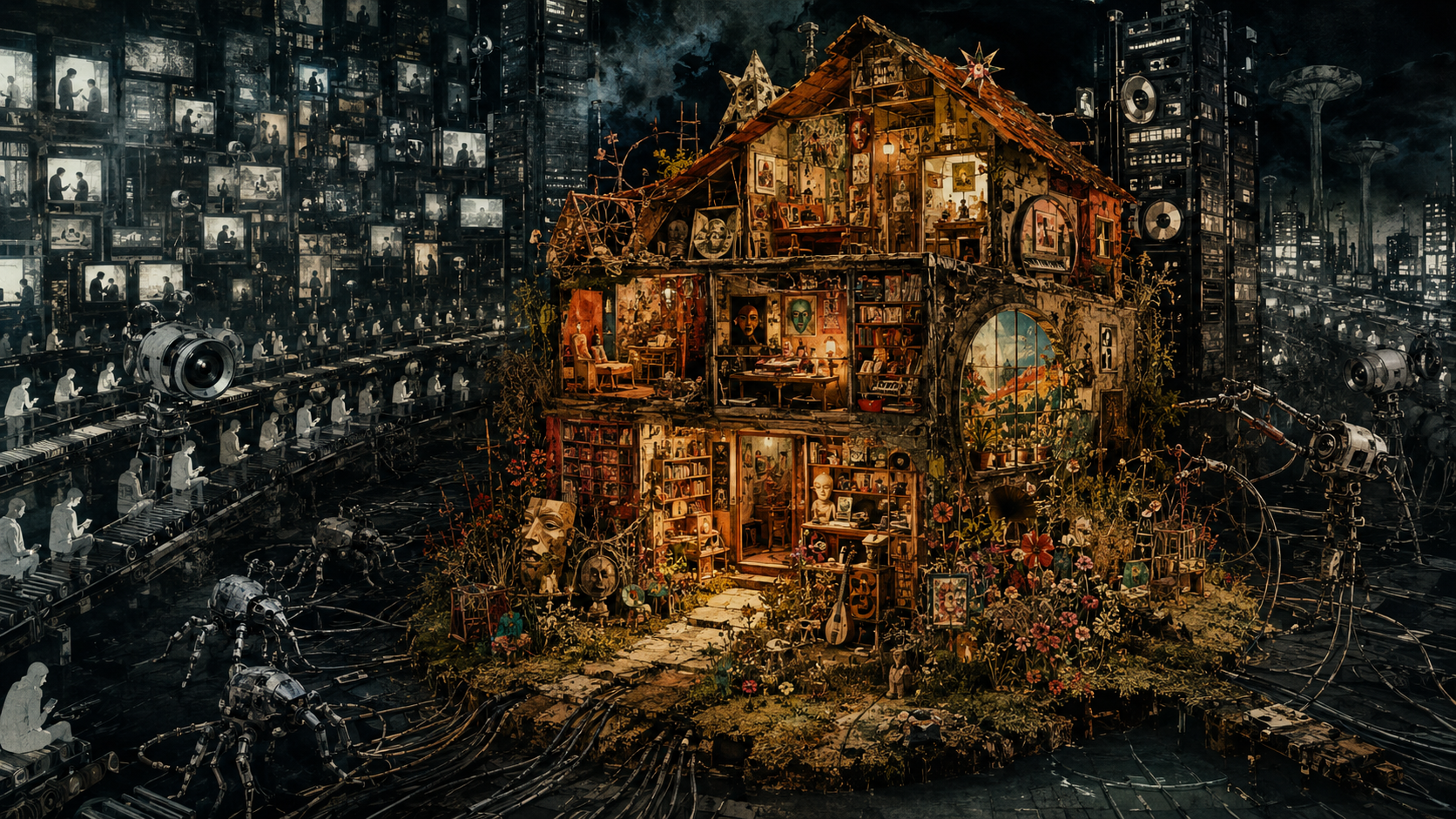
Bring Back the Website and Revolt Against the Algorithm
The personal website was one of the internet's finest inventions. It let an ordinary person become a publisher, archivist, artist, critic, and broadcaster without first getting permission from a corporation. The creator decided what appeared, how it was organized, and how long it remained available. Visitors deliberately traveled to that person's address rather than encountering fragments of their identity inside an endlessly ranked feed. As communications scholar Joseph Dominick observed in 1999, personal homepages gave ordinary audience members an unprecedented opportunity to become producers of mass communication rather than merely its consumers.
I am not arguing for this only as an abstract principle. Sekdek.com is my attempt to be somewhat off-grid. My site is the accumulated creative world of me: music, albums, books, photography, graphics, illustration, video, podcasting, woodwork, criticism, autobiography, cultural research, and decades of strange archival evidence gathered into one address. It is everything in one spot because I like to organize stuff. It is the whole animal rather than a cut of meat.
The Enclosure Nobody Voted For
The distinction matters because social media improved nothing about the personal website. It enclosed it. The personal website became culturally obsolete because social life migrated into a handful of privately owned platforms, and the platforms had better roads. Scholar Anne Helmond describes this transformation as the "platformization" of the web: content production remains distributed among millions of people, while data collection, visibility, and economic control are recentralized inside a few corporations. We still produce the photographs, writing, music, arguments, jokes, and friendships. The platform owns the theater, controls the seating, selects what appears onstage, and sells audience access.
Sekdek reverses that arrangement as much as one independently maintained website can. Its homepage opens into an enormous visual field of painted bodies, altered figures, masks, textures, mythological forms, studio experiments, and recurring attempts to transform the grotesque into the divine. The work confronts fear, humor, death, psychedelia, religion, monstrosity, and the human shadow. Baphomet, Shiva, Medusa, Quetzalcoatl, and Vlad the Impaler enter the frame as archetypes and leave it as something closer to friendly, enlightened beings — the stigmata of evil extracted from imagery and reissued as radiant gruvy light. Each image earns its place through accumulation rather than through a machine's prediction that one figure will outperform another this Tuesday. The meaning lives in the mass. An ethos that repeats across multiple projects. Including the overblown, way-too-involved, classically minimally-edited cover-song project Song Belongs to Room.
The Archive Holds
The music section presents recordings and compositions, while the album archive preserves a visual and musical discography spanning experimental, narrative, lo-fi, hypnagogic, psychedelic, and genre-crossing work — twenty-one albums and counting, released across the Sekdek and Milarepo Man (my trusty studio band) identities and through 38th Parallel Records. Song Belongs to Room documents my large-scale cover-song and vocal-performance project, in which I take apart and rebuild songs associated with Bauhaus, Elliott Smith, Prince, Soundgarden, Mazzy Star, FKA Twigs, Ozzy Osbourne, Slint, Pink Floyd, Nick Drake, Ween, Nirvana, The Hollies, Cat Stevens, Billie Eilish, Chris Isaak, Solomon Burke, Lady Gaga, Jim Croce, Radiohead, Tears for Fears, The Velvet Underground, Pavement, Sia, The Pogues, Danzig, R.E.M., Leonard Cohen, Bread, Billy Idol, Gary Jules, Ariel Pink, Sparks, Hot Chocolate, Gotye, Cyndi Lauper, Four Non Blondes, Harry Nilsson, Grandaddy, The Cars, Propaganda, J.J. Cale, Nick Gilder, Slayer, Angelo Badalamenti, Jimmy Scott, Faith No More, Metallica, The Neville Brothers, Atari Teenage Riot, The Prodigy, The Misfits, Fugazi, Benjamin Clementine, and many others inside my own recording environment.
The books combine photography, blurbs, and conceptual 2-d work in physical form. Behind the Screams exposes the costumes, sets, supplies, accidents, studio tricks, failed experiments, and improvised processes behind the Sekdek mythology. The graphics and illustration archive preserves drawings, album concepts, posters, graphic experiments, and visual studies that would read as noise if reduced to one isolated Instagram post. The video archive includes experimental films, animations, performances, independent-label commercials, music videos, collaborations, and cultural YT debris extending across decades. It includes my directing work for Elettrodomestico — the Jane Wiedlin and Pietro Straccia project — as well as a song I recorded in 2002 that later appeared in the opening of The Comedy Club.
Elsewhere, Sekdek documents the construction of a 500-pound concrete diamond sculpture from a van and garden studio, accompanied by my performance of Ween's "Tender Situation." It contains an Antarctic journey combining hiking, photography, field recordings, isolation, and music. The Sekdek Podcast preserves conversations, recordings, songs, ideas, and the evolving creative process. The woodwork section connects this artistic practice to physical construction and the practical intelligence of making real objects in real space, which is also how I earn a living.
My loosey goosey writing archive moves without institutional permission between music criticism, memoir, technology, artificial intelligence, psychedelia, obscure cultural history, social policy, friendship, death, humor, artistic process, and ordinary aggravation. One essay examines the hostile design of corporate telephone hold queues as a system for monetizing captive attention. Another investigates the repackaging of serial murder as shopping-mall entertainment. Other pieces move through Antony and the Johnsons, Elliott Smith, Sunn O))), Amon Tobin, Taraf de Haïdouks, Pietro Straccia, lost San Francisco characters, childhood paintings, artificial intelligence, and the private cosmology that connects these subjects in my mind. The full INDEX exists for anyone who wants the map before the territory.
Context Is the First Thing the Feed Destroys
A social-media algorithm divides this material into disconnected units and tests each one for immediate performance. Sekdek keeps the relationships among them visible. A song sits beside the sculpture built while recording it. A travel photograph leads into a field recording, then into an essay about isolation. An album cover becomes legible alongside the drawings, costumes, photographs, and psychological history that produced it.
This is the actual loss, and it is larger than reach. A feed is a machine for stripping context and selling the residue. Yes, you can build up your vibe and do some stuff to build your brand. But that brand look is homogenized to a great degree, since you only have so many presentation options on platforms. It takes a body of work, atomizes it into units small enough to be ranked, and then discards every unit that fails a test the maker never agreed to take. The artist experiences this as invisibility. The audience experiences it as a strange flatness — an endless supply of fragments that never assemble into a person. Or it assembles a different avatar person version of you. Not that a website is suddenly a full person, but it is less Borg than platforms. You have to make more choices and present your brand or your stuff somehow. If that is an HTML site and you think it looks cool as-is, retro-sick, then so be it. You get to do that. However you do it, both parties are being cheated, and usually only one of them gets paid. A website can be a work of art in itself, but your feed on FB is just like everyone else's to a great degree. All obvious stuff here.
An Archive You Do Not Own Is Digital Decay
Platforms are not really archives. They are storage lockers with a landlord who can change the locks, raise the rent, or bulldoze the building, and who owes you nothing when the bulldozer arrives.
The measurements are grim. Pew Research Center found that a quarter of all webpages that existed at some point between 2013 and 2023 had become inaccessible by October 2023. Of pages that existed in 2013, 38 percent were gone a decade later. Even pages published in 2023 failed at 8 percent within the year. Nearly a quarter of news webpages and a fifth of government webpages carry at least one broken link, and more than half of Wikipedia articles contain a dead reference (Pew Research Center, 2024). Social platforms decay even faster: in the same study, roughly one in five tweets vanished from public view within months of posting, with most of those disappearances traced to accounts that went private, were suspended, or were deleted.
A fifth of a public conversation evaporated inside a single season. Everything a person posted, everything they replied to, everything anyone said back — gone, not through censorship but through ordinary attrition, the platform equivalent of a warehouse fire nobody bothered to report. Every creative decision made on rented land is a bet that the landlord will outlive your interest in the work. That bet has an established losing record. By the way, I had not opened my FB account for over a year, and they deleted the entire thing. All those years of accumulating interesting people and many others I don’t really care about losing track of…But I will never get any of that back. I did not get an email warning or anything. So yes, you are punished in a way if you don’t log in frequently. Deleted from society, really. Probably for the best, as I would constantly threaten to delete it myself but never had the balls. Def a few unique connections on there that I don’t have now. You know they still have everything in some vault too. All those items I may have gone back and tried to delete.
As if deleting things ever really works. Ask Hunter Biden about that. Most of what they found and presented was stuff he deleted, and stuff that had nothing to do with his laptop, etc. So he says. Which I get is pure rubbish conspiracy talk, but also highly probable and realistic. Not to forgive any egregious crime stuff there, but to then shame someone so definitively and show their worst caught moments during a drug binge or while they are unconscious and clearly not the one taking the photo? It seems like they crossed a line, and no one really called it out. Why is this article turning into a Hunter opinion piece? Stop dude. You are not trying to be an apologist, but on some level, Hunter Biden was probably one of the biggest rock stars of our generation. ps... If political figures have become that instead of actual rock stars, this era has major issues. They just wanted stuff on him, and a good hacker can go backward and find dirt, deleted photographs, and things you already edited. This is essentially thought crime being punished, too. If we are not allowed to edit words or photos and choose what we are willing to share with the world, then what freedom of privacy do we have? I mean, I’ve messaged my way through multiple break-ups right there on Facebook, like a total idiot. This isn't good for me if these emotional moments were publicly available. Every one of us has experienced similar moments of emotional imperfection and compulsive passionate exaltation. But just know, if it ever exists in your head, even on a scribble pad you throw away right after, it is essentially public. This era sucks balls in that way. Privacy is a total joke. Just hope you are never the target. Be perfect. Be inhuman. Pay us, comply, sign here, or else. We are hostages, and anything we sign or agree to anywhere online, on any platform, or for any access, etc., is us under duress. Opinions, and I digress. In any case, I tend to publicize my worst anyways willingly. Not like I’d ever be able to run for office at this point. Or even get a job. Such is the life of a rebel without a cause.
My point here is, an archive means durable addresses, preserved sequence, and a custodian with a personal stake in the material. Sekdek keeps its own URLs. When a page moves, I move it. When something is worth preserving, it stays available because I decided it stays available, and I don't delegate that decision to a ranking system optimizing for a metric invented in Menlo Park. I have driven around Menlo Park many times for blue-collar work. It is abysmal in that way. It is like one big, expensive 15-minute strip mall. With no strip clubs. And drinks are $17.29.
The Reach Was Always a Loan
The counterargument runs that platforms at least deliver an audience. They delivered one, past tense, and then reclaimed it without notice. An audience of their choosing and maybe not your chosen.
The publishing industry provides the receipts, because publishers instrument everything and artists instrument nothing. Facebook's share of external referral traffic to a large sample of news and media sites fell to about 6 percent by December 2023, down from 14 percent five years earlier, and its share of those publishers' social traffic dropped from roughly half to a third in a single year. Across dozens of major news sites analyzed by Press Gazette, Facebook's share of total referrals collapsed from around 30 percent in March 2018 to about 7 percent in March 2024. Some of the world's largest sites lost more than half their Facebook traffic in twelve months, mainly because Facebook deprioritized link posts and dismantled the news product.
Says GPT, because I asked it to provide forgettable but accurate data for my article, hence adding bulk and seeming legitimacy as if trying to write one of those college papers and just using run-on sentences to solve the word count issue because thinking for myself seemed inaccessible at the time and I was not sure how to write anything much past song lyrics or broken and revealing and embarrassing letters to people that I was begging to remain close with. “And therefore kinda like due to my previous statement about A and such, one would have to deduce that item B is then therefore probably and inherently actually and theoretically poetically C.”
Organizations with lawyers, analytics teams, and audience-development departments absorbed that hit. Consider what the same policy shift does to one person with twenty-one albums and a garden studio. Nobody sent a notice. Distribution simply stopped, and the work that had been supplied free for a decade kept sitting on the servers, generating data, generating ad inventory, and giving people reasons to stay inside the building and hate the underground.
What Happens When You Delete Facebook
The social consequences of leaving that culture become obvious the moment you leave it. When I ‘deleted’ my account, many of my supposed friends seemed to disappear. I kept trying to communicate in the traditional ways I learned in the 1990s: calling people, texting them (although not really the 90s), proposing projects, and trying to meet in person. Many of these direct efforts were ignored. I would then see the same people posting regularly on social media. Sometimes that same day. Asking the group about this or that concept or song or interesting appreciation — demonstrating that they were alive, available, and actively engaged with the Borg, while apparently finding direct contact inconvenient, intrusive, or burdensome. Try it. When someone ignores you, check how many things they posted while ignoring you. And judge the random things they posted. It will be shocking. And it will be very difficult to come to terms with. Why are their rare psychedelic Mexican bands from the 40s more important than you? Why is immigration much more interesting than you? Why does climate change really grab them by the teeth while simultaneously removing the lifeblood from your soul?
This is understandable to a degree, and the mechanism deserves more respect than the simple grievance. A public post requires very little responsibility. It can be directed at everyone and no one, creating the appearance of social participation without requiring a sustained response from anyone in particular. Easy ego massage and confirmation of legitimacy. A telephone call, personal message, or invitation creates an obligation and often confrontation. It asks for time, attention, and reciprocity. Platforms made ambient broadcasting effortless while direct friendship became comparatively expensive, and human beings, being economical creatures, route around cost. Especially now that everyone is somewhat autistic and mixed gender due to Glyphosate or whatever. Not saying I’m a woman, moreso, that I more deeply understand the plight of the female race. Maybe Glyphosate is like mushrooms in that regard. Everyone should do some at some point to gain that perspective. The frogs know; why shouldn’t you? That does not make these people cruel. It means the architecture trained all of us to prefer cheap visibility over demanding contact. I was guilty of the same behavior at times, and anyone honest about the last fifteen years was too. Beers with the cats were usually much more rewarding than that event meet-up.
Leaving the system can be psychologically healthy for someone who already has durable friendships. It removes compulsive comparison, manufactured outrage, advertising, and the constant pressure to perform an identity. Withdrawal also carries a severe social penalty, because the networks have become basic infrastructure. In 2025, 84 percent of American adults reported using YouTube and 71 percent reported using Facebook; half used Instagram; and roughly half of all adults visited Facebook or YouTube every day, with 37 percent checking Facebook several times daily. Once everyone gathers in the same few rooms, refusing to enter those rooms can make a person socially invisible.
Facebook once kept the dream of Brice Frillici faintly alive in the minds of roughly 500 people. I would occasionally meet someone in person and discover they knew what I had been doing. It produced a strange form of one-way telepathy,, considering I may or may not have put effort into examining their feeds. Yet I rarely knew who had actually seen the work, received few visible responses, and held no control over its distribution. For years I supplied a corporation with free, original material, only to have much of it buried whenever the system predicted insufficient engagement. That is the whole bargain in one sentence: I paid in labor and received a rumor.
The Terms You Already Agreed To
The legal texture is worth stating plainly, because most people who post daily have never read what they signed. Meta's terms of service provide that when you upload content covered by intellectual property rights, you grant the company a "non-exclusive, transferable, sub-licensable, royalty-free, and worldwide license" to host, use, distribute, modify, run, copy, publicly perform or display, translate, and create derivative works from it (Meta Terms of Service). You keep the copyright. They keep everything the copyright covers. The license ends when the content is deleted from their systems, which is a meaningful promise and a narrow one, since it says nothing about copies already distributed, already syndicated, or already absorbed into downstream systems.
Nothing about this is a scandal. It is disclosed, standard, and the ordinary price of a service that costs nothing at the register. The scandal is that a generation of artists uploaded a career's worth of primary material under those terms without ever asking what the terms were, and then expressed surprise when the material was used exactly as the terms said it would be.
Net Neutrality
Net neutrality is the principle that internet-service providers should not block, throttle, or favor particular online traffic. The FCC's 2002 decision to classify cable broadband as an "information service," later upheld by the Supreme Court in Brand X, reduced common-carrier regulation of broadband infrastructure (NCTA v. Brand X, 2005). That dispute concerned the pipes carrying internet traffic. It had nothing to do with Facebook's authority to rank a post once it arrived.
The legal history of platform power runs elsewhere. Section 230 of the Communications Decency Act limited the liability of online services for material supplied by users (47 U.S.C. § 230). The Digital Millennium Copyright Act created related protections for services hosting user-uploaded material (U.S. Copyright Office). These laws made large-scale online participation possible, and the internet I love exists because of them. The deeper failure is that America permitted platforms to reach planetary scale while establishing no comparable national protection for personal data, meaningful user control, or transparent distribution.
The resulting imbalance is severe: strong permission to collect and host human expression, weak restriction on extracting value from the people producing it. The Government Accountability Office has documented the absence of a comprehensive federal law governing the commercial collection, use, and sale of personal information (GAO). A major Federal Trade Commission investigation found that social-media and streaming companies collected enormous quantities of information from users and non-users alike, obtained additional information from data brokers, sometimes retained it indefinitely, and operated business models that rewarded mass surveillance through targeted advertising (FTC, 2024). I would never click these meta links, and that doesn't make my article powerful. I understand this. If you are reading this at all, that means you are wasting your time. And/or getting to know my inner concerns with reality on some level. Maybe valuable and therefore, not a waste of time.
Twenty-four years into this century, that vacuum remains, says Brice, standing on an invisible soapbox, declaiming to the void of reality. Picture Daniel Day-Lewis acting as me in my movie. States have filled it unevenly — roughly two dozen have now enacted comprehensive consumer privacy laws, each with its own thresholds, rights, and enforcement, and most without any private right of action. Fuckin-A right? Washington, where I live and don’t currently work, regulates through targeted statutes rather than a comprehensive framework. A citizen's protection now depends on which side of a state line they happen to sleep on, which is a peculiar way to run a country and an absurd way to run a network that ignores state lines entirely.
That was a lot of data. Have you enjoyed it? If so, like and subscribe to my website. No clicking required. Just think of me sometimes. And that is good enough.
A Web Where Machines Are the Majority Readership
The web is now, in the most literal measurable sense, a place written by people and read by software. For twenty years the bargain was simple: crawlers indexed your pages, search engines sent you visitors, visitors made publishing viable. Cloudflare's crawl-to-refer ratio measures how badly that bargain has broken. In mid-2025, the ratios ranged from Mistral sending ten visitors for every page crawled to Anthropic requesting on the order of seventy thousand pages for every single referral it sent back, with figures elsewhere in that year's data reaching into the hundreds of thousands to one. Roughly eighty percent of AI crawling in 2025 existed to build training corpora rather than to answer a live question and send a reader anywhere.
And the readers who remain are being intercepted before they arrive. Pew tracked 68,879 Google searches from 900 American adults and found that when an AI-generated summary appeared at the top of the results, users clicked a traditional link 8 percent of the time, against 15 percent when no summary appeared. Clicks on the sources cited inside the summary itself ran at about 1 percent. Users were also markedly more likely to end their browsing session entirely after encountering a summarized page.
All this data is stupid and depressing.
Meanwhile, the corpus itself is thinning into paste. Researchers working with the Internet Archive, Stanford, and Imperial College London estimated that by mid-2025 roughly 35 percent of newly published websites were machine-generated or machine-assisted, up from effectively zero before late 2022 (404 Media, 2026). The SEO firm Graphite, sampling English-language articles, found the split between primarily machine-written and primarily human-written articles hovering near even through early 2026 (Futurism, 2025). Both figures deserve skepticism — they rest on statistical detectors that cannot cleanly separate a machine's paragraph from a human's edited draft, and the popular framing that "half the internet is slop" claims far more than anyone measured. The direction is still unmistakable enough that Merriam-Webster made slop its word of the year for 2025.
Set those findings side by side. The audience is increasingly automated. The compensation for being read has collapsed by three or four orders of magnitude. And the material being produced is increasingly synthetic, which means the machines are now largely reading each other. The open web is turning into a vast, well-lit room in which software recites summaries of software to an audience of software, while the humans who made the original recordings stand outside wondering where everyone went.
This is where Sekdek.com stops being nostalgia and becomes strategy. When distribution is captured, the only defensible asset is the thing itself: a fixed address, a coherent body, a human origin that cannot be synthesized because it was lived. A machine can generate a thousand essays about experimental body painting tonight. It cannot generate the twenty-year sequence of photographs, the costumes, the accidents, the failures, and the specific afternoon in a garden studio when 500 pounds of concrete finally came out of the mold. Look how easily it generated this article? I am killing it.
A Confession
An argument this severe should be turned on its author, so here is the accounting.
Sekdek runs on commercial hosting. It uses search engines, streaming embeds, and content delivery networks owned by corporations whose interests are not mine. This very essay has been tuned to be found — headed, structured, and salted with the exact phrases that improve its odds inside the ranking systems it spends four thousand words indicting. I am optimizing for crawlers I have just described as the majority readership and the worst-paying customers on the internet. If you want to call that hypocrisy, I will not spend a paragraph fighting you. Just dig my site, man. That is all I am saying here. C’mon!
The romance also deserves puncturing. The 1990s personal web was frequently ugly, unfindable, and unread. Discoverability was a genuine gift from the platforms, and the only gift they ever gave, and every person who claims otherwise has forgotten what it felt like to publish into total silence. I have not forgotten this, though. I know it intimately. And I feel it now as if a silent, mid and uninterested angel sits on my shoulder smiling at me and wonders when I will learn. A website solves distribution for exactly one person: the one who owns it. It builds no audience by itself. It rescues nobody. Calling it secession flatters it — a homestead inside a company town is closer to the truth, and the town still owns the road, the water, and the map. Ugh.
Independence is now a matter of degree, and degree is what remains available. After a visitor arrives at Sekdek.com, no feed stands between that person and the work. The hierarchy, sequence, juxtapositions, and archive are substantially mine. Whatever the site promotes, it promotes the artist who made the work, rather than a larger corporation absorbing the work into an advertising machine. That is a smaller victory than the word "revolt" implies. It is also the only one on offer, and I would rather hold a small piece of ground than rent a large one. Nonetheless, I have linked my website and directed some SEO to my site with fakeass authorship of this article. I realize no one believes that just because I inject my quips and quacks in the face of the machine that feeds me, this is genuine and, in many ways, a false narrative about the truth of Brice Frillici. But I am doing what I can against impossible odds.
The Small Web Is Bigger Than You Think
The encouraging part is that this instinct is spreading without any organization behind it. The IndieWeb community has been quietly rebuilding these practices—owning your domain, publishing at home first and syndicating outward (POSSE), and connecting sites through open standards rather than a corporation's graph. Homebrew Website Club meets on schedule. RSS readers still work perfectly and always did. Neocities, digital gardens, blog carnivals, and personal wikis keep multiplying in the space the feeds abandoned. None of it will displace Google or Meta, and none of it should try. The point is to proliferate human-scale places rather than build a single better cathedral.
If any of this lands, the useful response is not to congratulate me. It is to register a domain, put your own work at your own address, and link outward to three people whose work you actually admire. That single act does more for the open web than a decade of complaining about algorithms, and it costs about as much per year as two decent lunches.
Start Anywhere
Go to Sekdek.com. Start anywhere. Listen to an album. Examine the painted figures. Open the books. Follow the cover-song project. Watch an old video. Read an essay about music, artificial intelligence, Antarctica, corporate hostility, or some obscure figure from the San Francisco underground. Every visitor is welcome to dislike most of it. I’m open to negativity and harsh critique. Call me and tell me personally how much I suck. 415 846 7825. The point is that a visitor can encounter a person in full rather than receive a few profitable fragments selected by a machine.
What did we trade for convenience? Control over our archives, our privacy, our attention, our audiences, and some of the basic rituals of friendship. In return we received effortless broadcasting and an increasingly poor imitation of human contact — and now, at the far end of the deal, an audience of crawlers that reads everything and returns nothing.
It was a crude trade. Sekdek is my small act of secession from it: a living beacon of what the personal web once permitted and what it can still become, kept at a fixed address, by a human being, on purpose.
Just.. do it.